

La p谩gina que intenta visitar s贸lo est谩 disponible en ingl茅s. 隆Disculpa!
The page you are about to visit is currently only available in English. Sorry!

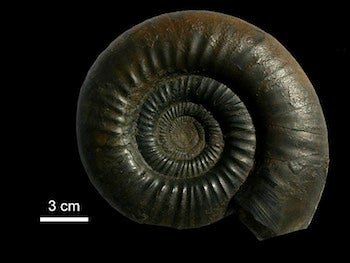
Courtesy Wikimedia Commons
These days, there鈥檚 a fair amount of talk, unfortunately, about species extinction. But what does that mean, really, for our ecosystems going forward, long after our lifetimes? We can look to rocks鈥攖o the fossilized past鈥攆or clues.
Recently, geologists at Brown University created a 50-million-year fossil record in western Canada for ammonoids鈥攕mall, spiral-shelled mollusks related to 鈥攖o learn more about two of the five mass extinctions in Earth鈥檚 history: the first at the end of Permian period, 250 million years ago, when 90 percent of species disappeared; the second at the conclusion of the Triassic, 200 million years ago, when 72 percent vanished. It鈥檚 thought that global volcanic eruptions caused these catastrophic extinctions by spewing greenhouse gases into the atmosphere, drastically altering the world鈥檚 climate.
There were two main types of ammonoid: one that simply drifted, and another that actively swam after prey. Following these mass extinctions, however, the swimming version is conspicuously absent from the fossil record. This, , suggests a lack of 鈥渆cological redundancy鈥� or, in essence, a radically simplified food chain鈥攕o simple, in fact, that it prolonged the ocean ecosystem鈥檚 recovery. Why? After these mass extinctions, the remaining ecosystem (composed of those species left standing ... or, drifting) was more vulnerable to minor environmental changes, as compared to an ocean at climax diversity. Smaller bumps in the road, so to speak, stalled and set back the ocean life鈥檚 long, winding drive for complexity.
In other words, . Evidence for the ancient ocean's minimal resilience, post-mass-extinction, can be found in 鈥渃haotic carbon episodes,鈥� during which carbon isotope values鈥攖ied to changing burial rates of dead organisms and the availability of nutrients (i.e. overall biomass)鈥攆luctuated. After the Permian and Triassic extinctions, isotope values finally stabilized, returning to "normal" levels, just when swimming ammonoids reappeared. What this may signal is that, after millions of years of species immigration and evolution, the ancient ocean鈥檚 ecosystems were resilient once more.
This theory has bearing, of course, on Almost a third of marine species, including many gamefish, have declined drastically in the past forty years, and coral reefs, especially, are in trouble. 鈥攚丑别苍 that lives symbiotically inside them鈥攕econd only to 1998, most notably in Southeast Asia. Severe bleaching bouts can be permanent, leading to the death of coral colonies. The phenomena is exacerbate by periodic El Nino/La Nina events, and yes, by climate change. Worldwide, reefs have diminished by 19 percent since 1950, and another 35 percent could give up the ghost over the next 40 years as oceans warm. That鈥檚 bad news for ecological redundancy: Though corals cover just .2 percent of the world鈥檚 oceans, they account for 25 percent of marine species.
Reefs have been described as "the ocean鈥檚 canaries鈥�; their loss heralds a downward spiral for ecological redundancy, for biodiversity鈥攖he same indicated by the disappearance of ammonoids 200-250 million years ago. "Because we know it's happened at least twice before. And you have long periods of time before you have reestablishment of ecological redundancy." Just how long? Well, swimming ammonoids reappeared in the fossil record after about 10 million years.