

La p谩gina que intenta visitar s贸lo est谩 disponible en ingl茅s. 隆Disculpa!
The page you are about to visit is currently only available in English. Sorry!

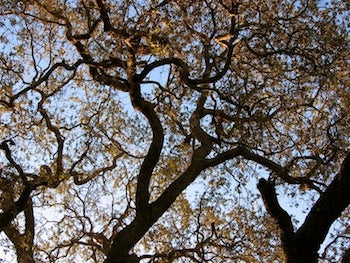 Courtesy of Randy, Wikimedia Commons
Last week in the city of Arcadia, outside Los Angeles, a grove of 250 oaks and sycamores was cut down to make way for 500,000 cubic yards of sediment that, for 60 years, has collected behind the nearby Santa Anita Dam and, now, must be dredged and dumped somewhere. In protest, several tree sitters took to the canopy, some of which was over 100 years old, but to no avail. As :
| Among them was Julia Posin, 23, an anthropology student at UCLA. "It was my first tree-sitting, and I could never have prepared myself for what I experienced," she said. "They were pulling branches off trees with chainsaws and bulldozing the trunks. Startled birds did not know where to go in the chaos."
"I started to cry in the tree," she added. "A forest that had taken a century to create was demolished in a matter of hours.鈥� |
The Pasadena 糖心传媒 Society and others campaigned to save these particular trees, which stood on 11 acres of Los Angeles County land, arguing that surely another solution could be found. The lot was a place worth saving, as the preamble to :
| This woodland, which includes oak, sycamore, California bay, elderberry, toyon, sugar bush and many other native plant species, provides habitat for bats, deer, bear, owl, hawk, and other bird and wildlife species. 鈥� [It] is located at the northern end of an urban trail and, as flatland with a wide road winding through it, is especially suitable for children, the elderly, and equestrians 鈥�. |
And yet, the local neighborhood association chose not to stand up for the trees, because the alternative, they were told, was 100,000 trucks a year rumbling through their streets, creating safety and pollution problems. That鈥檚 a tough call鈥攑erhaps one that no neighborhood would have to make, if the greater community (which certainly benefits from the reservoir) were to help conceive and fund a better option.
Up in Seattle, meanwhile, it seems about to make way for a viaduct. They鈥檙e smaller鈥攐nly three-to-10 inches in diameter鈥攕o the City has offered them free to anyone willing to organize and pay for one or more to be transplanted. But, that's a tall order: relocating a 30-foot tree is likely to cost about $15,000 dollars.
Trees have always fallen in the wake of progress, and it鈥檚 not always possible or economical to save them. (If a stand of trees falls in the forest, meanwhile, and there鈥檚 no media to hear, does it make a sound? Rarely.) But whenever a tree is saved, it鈥檚 rather uplifting鈥攁ll the more so in cities. Maybe someone in Seattle should buy one or two of those maples, for the sake of a positive story? Or imagine if every city, or county, set aside an emergency tree fund to help save a neighborhood grove, someway somehow, in a pinch.