

La p谩gina que intenta visitar s贸lo est谩 disponible en ingl茅s. 隆Disculpa!
The page you are about to visit is currently only available in English. Sorry!

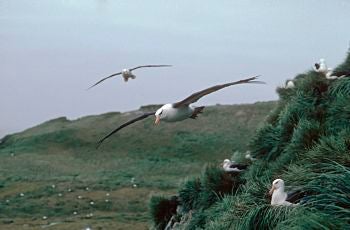
Black-browed albatrosses at Bird Island. British Antarctic Survey
Following a killer whale might seem like a good way to end up as the deadly predator鈥檚 meal. But for black-browed albatrosses, that fly hundreds of miles across the open ocean in search of prey, shadowing the massive mammal might mean a veritable feast at sea. Lipstick-sized cameras mounted on albatrosses nesting on Bird Island in South Georgia showed a surprising scene: the birds actively following an orca and apparently devouring food scraps left over from the diving mammal鈥檚 kill in the Southern Ocean.
鈥淭he images of the killer whale were entirely unexpected because killer whales are rare in the region, and as far as we are aware, there have been no previous records of albatrosses feeding in this way,鈥� says Richard Phillips of the British Antarctic Survey, who, along with colleagues at Japan鈥檚 National Institute of Polar Research, reported the finding this week in the journal .
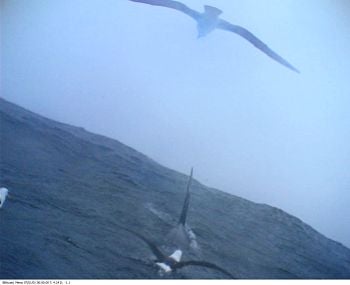
Albatrosses interacting with a killer whale. National Institute of Polar Research, Japan
鈥淢arine mammals often drive or bring captured prey to the surface. The albatrosses in the pictures were almost certainly feeding on scraps of fish, squid, seal or penguin as it was dismembered by the whale,鈥� continues Phillips. 鈥淚t was very surprising because unlike tropical seabirds which often feed in association with subsurface predators such as tuna and dolphins, similar behavior, in this case involving a killer whale, has not previously been observed in albatrosses.鈥�
In January 2009, the scientists fitted three black-browed albatrosses with cameras and depth data loggers to try to better understand how the birds find their prey, which consists largely of krill. Still images and depth data logs revealed that the birds dived actively when they were trailing the killer whale and when other birds were present. Otherwise, they rarely plunged into the water. So the researchers hypothesize that the whale and other birds clue in the albatrosses when there鈥檚 food, allowing them to conserve their energy and dive only when there鈥檚 a chance of a meal.
Some technical adjustments might give them an even clearer picture of how albatrosses zero in on their prey.
鈥淭hese cameras were mounted on the backs of the birds and so the lens was often obscured by feathers,鈥� says Phillips. 鈥淭he intention is therefore to develop an even smaller camera that could be mounted on the bird's head so that we could see exactly what the albatross sees in order to gain even more insights into their foraging behavior.鈥�