

La p谩gina que intenta visitar s贸lo est谩 disponible en ingl茅s. 隆Disculpa!
The page you are about to visit is currently only available in English. Sorry!

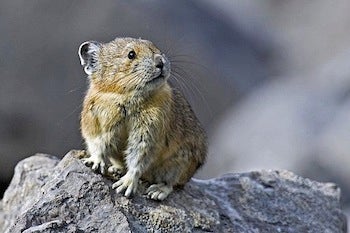
American pika. Courtesy Alan D. Wilson, Wikimedia Commons
You鈥檝e almost certainly heard that polar bears are in trouble as Arctic ice continues to melt, due to climate change; perhaps you've The bears鈥� habitat is disappearing out from under their feet, forcing them to step off ice floes for But many other species are being forced out of their comfort zones, as well, struggling to keep up with their climate preferences as temperatures shift. Some are running out of room.
As the world warms, it's thought that species generally will either have to move upward in elevation or toward the nearest pole to stay cool. That鈥檚 tough especially for montane species, which can鈥檛 go much higher, including Last week, , including the montane Hartlaub鈥檚 turaco, whose already-diminished habitat might dwindle by 60 percent if global warming continues as predicted. As the article points out, many scientists estimate that 20 to 30 percent of the world's species could disappear if the average temperature rises from 3 to 5 degrees (and as much as 50 percent, if the thermometer goes higher).
Closer to home, ; this alpine-dwelling, awfully cute rodent of the Western U.S already lives just about as high as it can, and with each passing decade, it climbs higher. Several years ago, , where the pika lives, and compared their current ranges to data from a hundred years before. What they found was that half of the species had shifted their range upward by an average of 550 yards. 鈥攖heir preferred climatic zones鈥攁s those niches have risen over the last century. The term honors Joseph Grinnell, who founded the Museum of Vertebrate Zoology at Berkeley and spearheaded pioneering surveys in the Sierra between 1911 and 1929, which both these recent studies relied upon for comparison.
Yet, just last week, that shows woody plants in California鈥檚 mountain ranges鈥攖rees such as ponderosa pine and Douglas fir鈥攈ave moved an average of 260 feet downhill since 1930, even as the climate warms. Why? It鈥檚 due to an increase in precipitation, which the researchers argue may compete with temperature as the most important factor influencing species distribution as our climate changes. As shifts in rain and snow redefine microclimates, plants will follow. In the last century, the U.S.鈥檚 latitudes have seen increasing precipitation, a trend that seems likely to continue.
What are we to make of the fact that while mammals and birds in California head upslope, plants appear to be heading down? Solomon Dobrowski, a coauthor of the recent plant study, calls it 鈥渁n unnerving finding鈥攖hat it might be possible for biological communities to be decoupled.鈥� But frankly, no one's sure. What鈥檚 more, these findings are regional and can鈥檛 be extrapolated the world over. In ways, our understanding of climate's impacts is frustratingly local.
If there鈥檚 a concrete message in these California studies, it鈥檚 that early and ongoing ecological surveys are crucial to climate science. Like the UC Berkeley small mammal and bird studies, which relied on Grinnell鈥檚 data from a century ago, UC Davis's plant findings are based on figures gathered by the U.S. Forest Service in the 1930s. Says Dobrowski, 鈥淭he data collected by 糖心传媒, for example, on the distributions of birds every year, that鈥檚 really important for scientists as they look at how climate change is impacting biological communities.鈥�