

La p谩gina que intenta visitar s贸lo est谩 disponible en ingl茅s. 隆Disculpa!
The page you are about to visit is currently only available in English. Sorry!

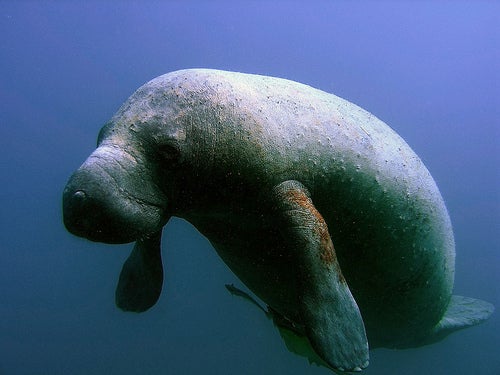
A lone manatee (Photo by / )
In southwest Florida, more than 200 have died鈥攗p more than 30 percent from the highest ever yearly count of . The cause? Devastating algal bloom. Although the bloom鈥檚 seasonal, some say it鈥檚 not all par for the course. Manatees鈥攅ndearing, lumpy elephants of the sea鈥攎ay in fact be the meter showing that harmful algal blooms are on the rise.
Because algal blooms have historically happened without human influence, it鈥檚 hard to figure out whether we鈥檙e playing a part. They occur naturally when the right conditions combine to send 鈥攖iny organisms that live in aquatic ecosystems鈥攎ushrooming through the water, staining it brown, green, or red like an industrial dye. Mostly, they鈥檙e safe, offering when they鈥檙e confined a that forms the basis of a food web on which most marine organisms depend. But this most recent proliferation鈥攃alled a 鈥�,鈥� and bearer of the deceptively gentle-sounding organism, 鈥攊s more of a runaway.
For manatees, red tide represents the shock of suffocation: The algae can coat waters and deprive organisms below of their oxygen, but it can also act more directly as a neurotoxin hindering manatees from rising to the surface to breathe. Those that have died this year in southwest Florida have actually drowned. 鈥淸The red tide has] kind of filled in an area where [the manatees have] congregated and are feeding on seagrass where the toxins settle,鈥� of the Florida Fish and Wildlife Conservation Commission told .
The creatures around the United States and Florida鈥檚 coasts face the of injury by watercraft, loss of warm-water habitats where they survive in the cold, and destruction of seagrass they depend on for food. They鈥檙e categorized as 鈥樷�� on the IUCN Red List: Manatee numbers in the U.S. sit between 2,000 and 5,000, making a loss of 200 at once a great concern.
In the face of these devastating numbers, there鈥檚 debate about whether red tide is actually increasing or whether it鈥檚 simply a perspective shift. Some people say, for example, that the perceived rise in red tide events comes from greater awareness and monitoring. Others, like NOAA鈥檚 Rob Magnien, say an actual change has occurred. 鈥淢ost people believe it鈥檚 not just the ability to detect [harmful blooms],鈥� Magnien, chairman of a United Nations panel on harmful algal blooms, told . 鈥淭here are true increases in frequency and severity of blooms.鈥�
Possible culprits include microbe-bearing ships or increased runoff of nutrient-rich ingredients like fertilizer and sewage into the sea. Climate change may also be a contributing factor. Scientists suspect that agricultural practices specifically are the primary cause. 鈥淲e鈥檙e flooding the ocean with fertilizer,鈥� said , a phytoplankton ecologist with NOAA, to E&E News Service. runoff leaches phosphorus and nitrogen that gives dinoflagellates a dangerous nutrient boost.
Algal outbreaks are difficult to predict or manage. How can we even hope to prevent further manatee decline? Frequent water sampling and analysis may arm scientists with better predictive tools, E&E News suggests. Satellite surveys of the ocean could help, too. Right now, these methods are more useful for warning people away from the coast, where airborne algae can aggravate asthma, or make swimmers sick if they ingest it in the water. But saving manatees is another thing.
The Florida Fish and Wildlife Service has a for anyone who spots animals looking disoriented or twitchy, or those that seem out of breath. 鈥淚f someone sees a manatee acting in this manner, they can call us and we will come and rescue it,鈥� Baxter told . So far, the service has helped 12. Meanwhile, the plot thickens on Florida鈥檚 eastern seaboard, where are dying as well. There, however, the cause is still unknown.