

La p谩gina que intenta visitar s贸lo est谩 disponible en ingl茅s. 隆Disculpa!
The page you are about to visit is currently only available in English. Sorry!

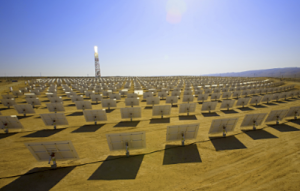
Photo: BrightSource
The nascent solar industry here could learn from the struggles the industry has endured in Spain, an in today鈥檚 New York Times. Subsidies spurred an explosion of solar plant development in last decade, 鈥淏ut as low-quality, poorly designed solar plants sprang up on Spain鈥檚 plateaus, Spanish officials came to realize that they would have to subsidize many of them indefinitely, and that the industry they had created might never produce efficient green energy on its own,鈥� Elisabeth Rosenthal writes. 鈥淚n September the government abruptly changed course, cutting payments and capping solar construction.鈥�
While some of the larger companies have survived, many smaller operations closed down. Rosenthal suggests that the U.S., where solar is a growing industry, might look at it as a 鈥渃autionary tale鈥� that 鈥減oints to the delicate policy calculations鈥� necessary for fueling a solar industry and creating green jobs. Read more .
Rosenthal focuses on the economic side of a burgeoning solar industry, but there are also important environmental considerations gaining public attention in the U.S. In February, the Energy Department that it would give BrightSource a conditional $1.4 billion loan guarantee for its as 392 megawatt solar thermal power complex in the Mojave Desert. As early as this year the company could break ground on the project鈥攚hich will use to a boiler filled with water that will make steam to run a turbine and produce electricity. The project will nearly double the existing generation capacity of solar in the U.S., and could create 1,000 jobs for construction, and 86 permanent jobs.
One of the conditions of the loan depends on environmental mitigation. Some environmental groups have argued that the project, which is being built on federal land, will negatively impact the desert tortoise and other rare desert species. As a result, BrightSource decreased the overall footprint of the complex by 23 percent and reduced the size of the project from 440 MW to 392 MW.
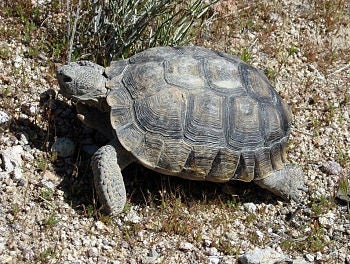
Desert Tortoise (Gopherus agassizii) in Rainbow Basin near Barstow, California. Photo: Mark A. Wilson (Department of Geology, The College of Wooster)
While many environmental groups saw the move as a step in the right direction, some are still pushing for the Ivanpah Valley to be moved to a more 鈥渟uitable鈥� site.
Defenders of Wildlife, for instance, is working with the California Natural Resources Agency and other local groups to develop a desert renewable energy conservation plan to guide balanced energy growth in the desert. 鈥淲e want to make sure that important desert wildlife habitat doesn鈥檛 become a solar sacrifice zone,鈥� said Kim Delfino, Defenders of Wildlife鈥檚 California program director, in the group's . 鈥淩enewable energy can be part of California鈥檚 clean-energy future, but it has to be done right and in the areas that cause the least environmental harm.鈥�
The Nature Conservancy, meanwhile, is working on a nationwide 鈥榟uman footprint鈥� project to identify lands suitable for energy development that will cause the least harm to wildlife.
Materials on the federal Office of Indian Energy and Economic Development website indicate that ecological impacts of solar projects include: disturbing wildlife, mortality of birds colliding with facilities or being burned by concentrated solar rays, habitat fragmentation by access roads and fences. 鈥淭he presence of a solar energy project could also interfere with migratory and other behaviors of some wildlife,鈥� .
It鈥檚 refreshing to see so much discussion about using a science-based approach to siting solar energy projects. Renewable energy is good for the climate鈥攚e should make sure it isn鈥檛 bad for our wildlife and the habitats they depend on.