

La p谩gina que intenta visitar s贸lo est谩 disponible en ingl茅s. 隆Disculpa!
The page you are about to visit is currently only available in English. Sorry!

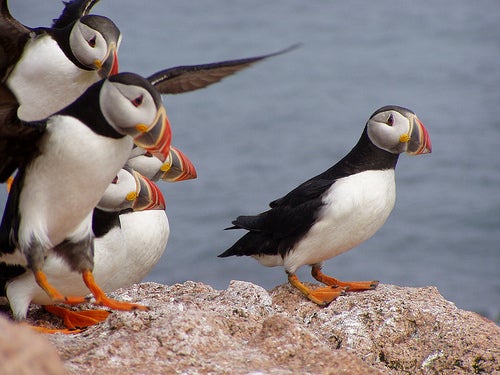
Puffins landing. (Photo by the / )
For Atlantic puffins鈥攚hose mournful expressions make them look as though they鈥檝e already got enough to worry about鈥攖his spring鈥檚 puffin census on the , off Scotland鈥檚 east coast, thankfully brought some good news.
Conservationists were bracing themselves for a sharp population dip since bad spring weather in March around the Isle of May鈥攐ne of which harbors the largest colony of Atlantic puffins in the North Sea鈥攈ad left thousands dead and washed up in a so-called puffin 鈥榳reck鈥� on English and Scottish coasts. What they found instead was that puffin numbers were roughly the same as they were when the last census was done, back in 2009.
This year鈥檚 results showed that 46,000 nesting burrows appeared to be in use, which was very close to the number that surveyors recorded in 2009.
This year鈥檚 harsh weather left at least 3500 puffins dead, and there was a concern that many of these deceased seabirds were breeding adults. The (CEH), which has upheld one of the oldest dedicated puffin studies by studying the seabirds on the Isle of May since 1972, that about 12% of the population was killed by the storm. They say this marks a 50% increase in the number of puffins that are usually lost at wintertime. But it appears that puffin numbers in the interim years between 2009 and 2013 had risen, which could explain the apparent constancy.
鈥淥ur general impression over the last few years was that the population was increasing slowly and this may explain why we have not seen a decline following the recent wreck,鈥� said , survey leader, and a researcher at CEH, in a CEH release.
Counting puffins isn鈥檛 for the fainthearted. The census involves tallying up the occupied burrows by reaching gently into the earthy hollows to figure out which ones are occupied and which are not. On the Farne Islands off of Northumberland, England, a similar census took place recently as well. There, David Steel, head ranger on the island, told the that even though he had an enthusiastic team, 鈥淎fter a while, they may be sick of it. The amount of bites and scars they are going to have will be interesting.鈥�
One possible negative that the Isle of May census did uncover was that the severe weather delayed breeding this year for the Atlantic puffins there. There are fears that some puffin pairs skipped breeding altogether. March鈥檚 storms 鈥渟eriously affected the timing of breeding with those birds that did survive breeding very late,鈥� Harris explained in the CEH news release. 鈥淚t would not be surprising if they needed a few weeks to recover and get into breeding condition. We now wait to see how successful these birds are in raising chicks this summer.鈥�
Some people see opportunity in this change. , reserve manager for the Isle of May, said to CEH, 鈥淭his late breeding could even result in puffins remaining at the colonies until later in the summer than normal, giving people even more opportunity to enjoy watching them.鈥�
That鈥檚 a hopeful prospect鈥攁nd a good reminder that there鈥檚 a way to watch Atlantic puffins this side of the pond as well, via the 糖心传媒 and Explore.org . You can catch these beauties hanging out this season on the 鈥楲oafing Ledge鈥� of Seal Island, Maine.