

La p谩gina que intenta visitar s贸lo est谩 disponible en ingl茅s. 隆Disculpa!
The page you are about to visit is currently only available in English. Sorry!

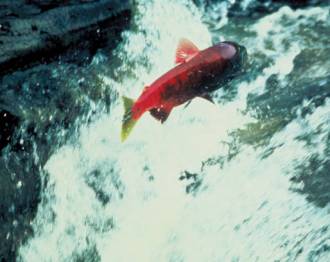
An Alaska salmon (Image: U.S. Fish & Wildlife Services)
Chances are good鈥攐ne in two, in fact鈥攖hat that fish you grilled over Labor Day weekend was farm-raised, according to a published yesterday in the Proceedings of the National Academy of Sciences. Researchers from several universities found that aquaculture, the farming of aquatic species (think salmon or trout farms), now accounts for 50% of all fish and shellfish consumed around the globe.
Our recent obsession with omega-3 fatty acids鈥攆ound in fatty fish like salmon and shown to reduce heart attack and stroke risk, as well as contribute to lower blood pressure鈥攊s partially at fault for the skyrocketing numbers, according to Rosamond L. Naylor, the study鈥檚 lead author and an environmental science professor at Stanford University.
Farmers have to keep up with the demand somehow. So they turn to fishmeal and oil from smaller wild-caught species, which in turn, depletes the smaller marine creatures鈥� populations. 鈥淎quaculture鈥檚 share of global fishmeal and fish-oil consumption more than doubled over the past decade to 68% and 88%, respectively,鈥� the study鈥檚 authors wrote.
The researchers offered several ways to decrease the environmental harm of farm-raising fish:
- Substitute fish-made fishmeal with feed produced from grain and livestock byproducts.
- Reduce the fish oil in the diet of farm-raised fish from which we get omega-3 fatty acids. Apparently, we鈥檒l still get what we need but from far fewer resources.
- Stop feeding fishmeal to vegetarian fish (e.g., tilapia). 鈥淓ven the small amounts of fishmeal used to raise vegetarian fish add up to a lot on a global scale,鈥� Naylor said, in a Stanford press release.
- Increase regulations on fisheries.
Whether you decide to eat wild fish only, farm-raised fish, or both is a personal choice. There are farm-raised fish free of antibiotics and chemicals (however, make sure you understand any label that says "organic"; the USDA hasn鈥檛 finalized organic standards for farmed fish).
Also, you can eat fish from farms near home, to reduce the carbon footprint. Finally, ask questions, such as whether the farm uses a recirculating aquaculture system rather than net pens or other open systems. With the former, it鈥檚 easier to control waste water, according to the . The latter can pollute its surroundings by allowing uneaten food and waste to seep into the water.