

La p谩gina que intenta visitar s贸lo est谩 disponible en ingl茅s. 隆Disculpa!
The page you are about to visit is currently only available in English. Sorry!

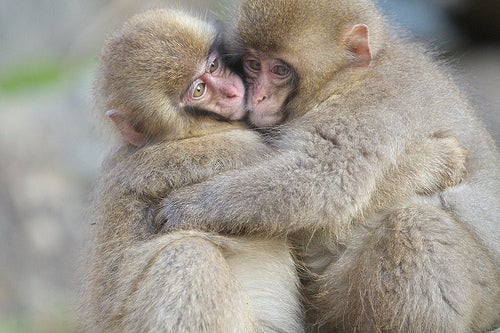
A monkey's embrace. (Photo: / )
We all love Disney鈥檚 animal parents鈥攖he ones that mate for life and raise their offspring together. Consider for example Mufasa and Sarabi, the in The Lion King. But in real life, far from the Disney screen, monogamy is only a feature in the lives of nine percent of mammals. It鈥檚 this degree of rarity that has driven puzzled biologists to seek a reason for its existence. Recently, two research papers have come out that hone in on a possible cause. But here鈥檚 the twist: both papers find that there are different drivers at play.
The reason the question of monogamy confounds researchers is because of the idea that technically, males 鈥榣ose out鈥� on breeding with other females when they attach themselves to just one life partner. 鈥淢onogamy is a problem,鈥� says Dieter Lukas, from Cambridge University and lead author on one of the papers, as reported by . 鈥淲hy should a male keep to one female?鈥�
His team鈥檚 theory on that puzzle formed the basis for the . In the non-human mammalian world, it all boils down to the female intolerance of proximity, they venture. The researchers included over 2,500 mammals in their study, and found that when ready to breed, females tend to enjoy space, which turns them into territorial creatures that fiercely protect their resources and maintain large distances between themselves and other females. This puts males in something of a pickle, because they can no longer gather together, guard, and maintain convenient harems of females with whom to breed鈥攖hey鈥檙e just too widely spread.
A choice must be made, and since the alternative is not breeding at all, males opt for the monogamous life, sticking close to just one female on her patch of turf, and mating with and 鈥榞uarding鈥� her, the logic goes. 鈥淚n mammals, social monogamy is a consequence of resource defense,鈥� said Lukas during a press briefing, as reported by . 鈥淔emale behavior is influenced by the distribution of food. And male behavior is influenced by the distribution of females.鈥�
But the found an entirely different driver for monogamy in mammals, which the researchers explored by analyzing the behaviors of 230 primate species, since monogamy is particularly prevalent in primates, the explains. In the paper, the researchers state that 鈥渢he most compelling explanation for the appearance of monogamy is male infanticide.鈥�
Before the advent of monogamy, a mother with offspring from one, absent, father (who was presumably roving around somewhere in search of other females) may have faced the risk of other males attacking and killing her offspring.
鈥淔or a male who knows he鈥檚 not the father of an infant, it can pay for him to kill that infant, because then he can make sure the female comes back into ovulation. And he can mate with her,鈥� the second study鈥檚 lead author, Christopher Opie of University College London, told . 鈥淚t鈥檚 a way for males to try to increase their genes that are passed into the next generation.鈥� Monogamy then, according to these researchers, evolved as a protective mechanism; a way to ensure the security and growth of one鈥檚 offspring.
The researchers, with their competing theories, say they had no idea the other was publishing a set of different results. For now, the papers remain at odds, but at least the discrepancies may motivate further research. Until scientists can corroborate each other鈥檚 findings on mammalian monogamy, however, it seems that Disney is an appropriate escape.
Related Stories
By Alisa Opar
By Alisa Opar
By Emma Bryce