

La p谩gina que intenta visitar s贸lo est谩 disponible en ingl茅s. 隆Disculpa!
The page you are about to visit is currently only available in English. Sorry!

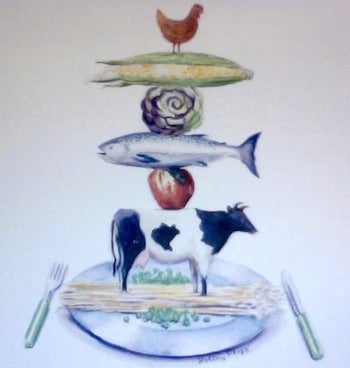
The fruit of vertical farming? Ilustration: Holley Flagg
Last month, the American Museum of Natural History held its 21st Annual Spring Environmental Lecture, attended by folks hungry first for a discussion of sustainable food in cities, and then a locavore luncheon (which alas, this reporter didn鈥檛 partake in). The event's panelists included Nevin Cohen, a professor of Environmental Studies at The New School; Dickson Despommier, a professor emeritus of Public Health at Columbia University; and Nancy E. Easton, the founder of the New York City nonprofit . Here鈥檚 just some of their conversation, to whet your appetite for more.
First, a few of the challenges. 鈥淎t the global level,鈥� Cohen began, 鈥渙ne big issue is climate change from our food system. Food production itself, plus deforestation to provide the grains to feed our livestock, represents nearly a third of global C02 emissions鈥� in part because of the need for long-distance shipping. Meanwhile agricultural plots surrounding cities are being paved over. 鈥淲e鈥檙e losing our farmlands, we鈥檙e losing our farmers, and we鈥檙e probably losing that institutional memory,鈥� said Despommier, adding that, by 2050, nearly 80 percent of the world鈥檚 population will live in cities.
How will those cities be fed sustainably? One piece of the puzzle is urban agriculture, not just on rooftops, but within buildings鈥�. Despommier's their champion. 鈥淚f we can catch the tail of a comet's dust, and bring it back to this planet and examine it, we can build a farm in a skyscraper,鈥� he said. , and last year, Despommier proposed another to the City of Newark, which expressed plenty of interest. But it's the funding, of course, that's key. 鈥淭he world needs to see that we鈥檝e done something other than invade countries, and things like that,鈥� argued Despommier. 鈥淲e need to spend our money better, and [vertical farming] is a great way.鈥�
According to Easton, supporting fresh local food, cooked right, is going to be essential to 鈥渦ndoing about 30 years of bad eating." Thirty percent of U.S. children are overweight, she said, and in New York City, it鈥檚 43 percent. When Easton was a teacher, she noticed that kids were consuming mainly 鈥渂ottles of something orange this big鈥濃�攃ue sweeping gesture鈥斺�渁nd bags of something orange this big.鈥� They were out of shape. So she was inspired to start , a nonprofit that brings trained chefs into NYC鈥檚 public school cafeterias to overhaul menus and teach healthy cooking in classrooms. She also has helped build a hydroponic garden atop her own childrens' school, making urban food integral to their education.
Planning needs to be a priority, too. 鈥淔or 100 years, city planners have pretty much ignored food as an issue,鈥� Cohen said. In addition to rooftop plots, cities also need to support mid-size farmers just outside their limits, allowing them to sell profitably in urban zones (and not just at farmers markets). Cooperative distribution centers are crucial, said Cohen. 鈥淲e can reorganize space in the city so that community gardens can thrive and we can experiment with all types of food production鈥濃�攔ooftop gardens, vertical farms, and the mid-sized farms that preserve open space on the fringe. 鈥淭he exciting thing about food is that it involves everyone,鈥� Cohen said, as stomachs began to rumble, 鈥渁nd there isn鈥檛 a one size fits all solution.鈥�
All three panelists pointed to the U.S. Farm Bill鈥檚 heavy subsidization of big agriculture鈥攐f mega-crops like corn and soybeans鈥攁s a major impediment to healthier farms and eating habits. By contrast, Easton pointed out, the average school lunch is budgeted just 96 cents. Despommier likewise shook his head in amazement. 鈥淚f we had 2 percent of that Farm Bill, you wouldn鈥檛 be asking me what is a vertical farm,鈥� he said. 鈥淵ou鈥檇 be asking me to have dinner in one.鈥� If you鈥檙e truly for sustainable food, the panel told the audience, then do more than garden鈥攚rite your Senators, as well.
But first, if you haven鈥檛 already, be sure to browse . Senior editor Susan Cosier鈥檚 article is especially apt.