

La p谩gina que intenta visitar s贸lo est谩 disponible en ingl茅s. 隆Disculpa!
The page you are about to visit is currently only available in English. Sorry!

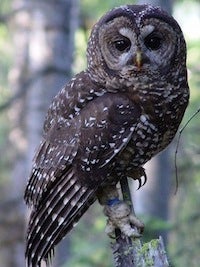
Courtesy FWS
Here鈥檚 fodder for an age-old, but hopefully not old-news, endangered species conversation:
In southern Washington, a timber company that owns a 45,000 swath of forest within reach of spotted owl nest sites--a holding it intends to harvest on a relatively generous 60-year rotation--has committed to a 鈥渟afe harbor鈥� agreement with the U.S. Fish and Wildlife Service and a 鈥渓andowner option plan鈥� with related Washington State agencies. In exchange for attention to habitat, this deal excepts the company for the next 60 years from sudden logging restrictions, should spotted owls move in. Additionally, the company, Port Blakely Tree Farm, would be absolved of any 鈥渋ncidental take鈥� down the line, should, say, one of those eventual falling timbers take out an owl, mid-glide.
As in depth, when Port Blakely bought the Morton Block, it was aware of nine nest sites nearby. What that meant was large portions of their holding could be rendered more or less uncuttable under Endangered Species Act provisions if spotties came to town鈥攁n obvious business conundrum. The very thought can lead to 鈥減anic cutting,鈥� a preemptive strike against encroaching endangered species. It鈥檚 happened elsewhere. But instead of panicking, Port Blakely cooperated with the agencies to come up with a plan ().
Now, their foresters are purposefully girdling trees鈥攕having a ring of bark from the tree, killing it鈥攖o make new snags that woodpeckers and squirrels will excavate for spotties, which nest in cavities. Port Blakely is also cultivating the understory, leaving woody debris, and thinning purposefully. In other words, they鈥檙e trying to speed up and simulate spotted owl habitat, ushering along an almost-old growth so that young birds can use it as a stopover ground, or even for breeding.
This is only the third 鈥渟afe harbor鈥� agreement geared toward spotted owls, and the first two involved much smaller plots. Whether it will really benefit the birds is up, of course, in the proverbial air. You might be able to create snags, but is it so easy to attract the rest of an old growth ecosystem to what's actually a 60-year-old, heavily-managed forest? And should a company be forgiven of incidental take (goodness forbid), out of hand? Few are sure.