

La p谩gina que intenta visitar s贸lo est谩 disponible en ingl茅s. 隆Disculpa!
The page you are about to visit is currently only available in English. Sorry!

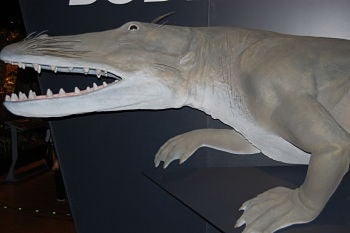
ON ALL FOURS: The walking whale is one of many extinct mammals on display at the American Museum of Natural History.
(Photo: Michele Wilson)
Typically, I鈥檓 skeptical of superlatives鈥攖he biggest, smallest, most amazing, etc. But the new at the American Museum of Natural History (whose name just cries for multiple exclamation points, doesn鈥檛 it?) actually doesn鈥檛 disappoint.
The smallest mammal ever鈥攖he itty-bitty, extinct Batonoides vanhouteni, reminiscent of a miniature mole and weighing less than a dollar bill鈥攁nd the extinct, elephant-like Indricotherium鈥攖he largest land-walking mammal, dwarfed only by the massive blue whale鈥攃rowd the exhibit鈥檚 entrance.
Winding through the showroom, you bump into models of a walking whale (a sort of alligator-whale-shark hybrid); the caramel-colored, horse-like Machrauchenia patagonia, which inhabited South America hundreds of thousands of years ago; even a glypotodont鈥檚 armadillo-like shell the size of a boulder, which smaller鈥攁nd luckier鈥攇uests can crawl through.
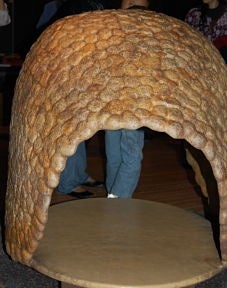
HOLY SHELL: Lucky visitors get to crawl through this natural armor of the glyptodont. (Photo: Michele Wilson)
As impressive as the stuffed animals were, two parts of 鈥淓xtreme Mammals鈥� left me in awe: the sugar gliders, the only live mammals in the exhibit, with big, pleading eyes the size of nickels (more about sugar gliders in this Friday鈥檚 video blog post); and the posters of newly discovered mammals, some as recently as 2005.
We know about 5,400 mammals, according to AMNH president Ellen V. Futter. But, she said during a press briefing, 鈥渨e鈥檙e still discovering new members of the clan. Some are pretty wild and weird. Some deserve special attention, what they can teach us.鈥�
John Flynn, the exhibit鈥檚 curator, can鈥檛 wait to learn more from these animals. 鈥淓xtinct mammals have everything that dinosaurs do and a whole lot more,鈥� he joked at the same press briefing. But on a more serious note, he added, in the exhibit, 鈥測ou will confront your humanity, but you will also encounter your deep mammal-ness.鈥�
Check back on Friday for a video about the exhibit, where you can learn more about the sugar gliders and several of the extinct mammals on display.
Exhibit info
Where: American Museum of Natural History
Address: Central Park West and 79th Street, New York City
When: May 16, 2009 through Jan. 3, 2010
Admission: $24 for adults, $18 for students and seniors, $14 for children ages 2-12. Note: Admission is by ticketed, timed entry only.
More information: