

La p谩gina que intenta visitar s贸lo est谩 disponible en ingl茅s. 隆Disculpa!
The page you are about to visit is currently only available in English. Sorry!

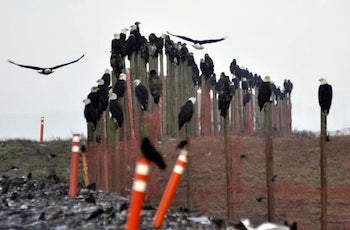
Photo: David Hancock
One afternoon last week, , pulled off the highway to talk to me on his cell phone while making his bald eagle rounds in the Fraser Valley, outside of Vancouver, B.C. He鈥檚 been studying birds of prey there, near his home, for 50 years, and this day was no exception, except it鈥檚 not so easy to get from A to B, to check your nests, when you鈥檙e being bombarded with eagle questions from across the country (and ). But Hancock jumped into this year鈥檚 story with such enthusiasm you鈥檇 never know he鈥檇 told it before. This is precisely what I鈥檝e come to expect of those who have made a life of birds of prey.
Fraser Valley is a biological wonder, Hancock enthused, a bird idyll, especially for bald eagles. Big runs of salmon lure eagles down from the north as the coast 鈥渇reezes up,鈥� and by early December, one or two thousand birds are usually on hand for the , which Hancock helps organize. This year, however, more than 7,200 birds gathered within a two-mile area on the Chehalis River, a tributary to the mighty Fraser River鈥攁 number even Hancock could hardly believe. Quite a lot of black and white had come to feast on .
But the chum never ran. Within 10 days, that huge congregation dwindled to just 348 birds. And that鈥檚 when it hit Hancock: 鈥淛oyous鈥� as it was to see 7,000 eagles in one spot, it presaged the worst. It suggested an ecosystemic failure. So many eagles had pinned their hopes on the Chehalis, because the chum run鈥攚hich, in terms of mass, Hancock says, is the largest of any of five salmon species that run along the Pacific Coast鈥攚as more or less a bust everywhere this year. Not only that, but the carcasses of the few salmon that had successfully died鈥攖hat is, spawned鈥攈ad been washed away by heavy rains. Wasted, in the eyes of an eagle.
鈥淚t鈥檚 a bit of tragedy,鈥� Hancock says. Later in December, he counted over 1,300 eagles one day at the Vancouver landfill鈥攁nother impressive sight, but one stinking of desperation. Hancock has studied eagles at the landfill for eight years, but he鈥檚 seen only 400 or 500 at a time, and usually just 30 or 40. This year, unable to rely on the aftermath of a huge salmon run鈥攐ne of nature鈥檚 most marvelous, messiest dumps鈥攖he eagles had turned to our version.
鈥淭he real severe problem,鈥� Hancock says, 鈥渋s that first- and second-year birds don鈥檛 know how to catch a thing. They are totally dependent on finding something dead, or stealing some peregrine鈥檚 duck.鈥� Those juveniles have been hit hardest, and more than the usual number of eagles have turned up in BC rehabilitation centers this year. 鈥淭hey鈥檙e just so weak, they end up landing on the ground, with no strength. Those are generally never seen. They walk under and hide under vegetation, and quietly die. But so many are dying this year, the public is seeing some of this.鈥� If eagles scavenge at dumps, they also risk being poisoned by what we鈥檝e thrown away.
Sounds dire, doesn鈥檛 it, but Hancock has kept his sense of humor. He鈥檚 seen eagles at many highs and lows, and his devotion to them has apparently remained the same. It all began when, at age 11, he caught his first hawk and became a falconer. At 15, he learned to fly and began surveying eagles by plane. The thesis he later wrote on eagles was sponsored by the Canadian 糖心传媒 Society. More recently, he authored a book called The Bald Eagle of Alaska, BC and Washington.
Humor does seem a crucial asset for those with long environmental careers. Of the landfill, Hancock says, 鈥淚 can鈥檛 say that it looks like a good food source, but then I don鈥檛 go out and eat rotting salmon carcasses, either.鈥� He鈥檚 quick to quip that the chemicals that have bioaccumulated in salmon tissue could be just about as tasty. As for why the chum run was poor this year? Could be overfishing. Salmon snack on herring, and they鈥檝e both been rounded up excessively, too. But these things also just run in natural cycles (or in the case of fish, don鈥檛 some years). Bald eagles are plentiful in BC and Alaska, but when fish crash, they crash land as well. Right now they鈥檙e bumming around Vancouver, some in shelters, until the herring arrive, hopefully in a a few weeks. This stretch of time between the December chum and March herring is precisely when BC鈥檚 eagles are most vulnerable. If it鈥檚 rough, some fly far inland. Others stake out our garbage.
In any case, Hancock keeps a watchful eye on them.