

La p谩gina que intenta visitar s贸lo est谩 disponible en ingl茅s. 隆Disculpa!
The page you are about to visit is currently only available in English. Sorry!

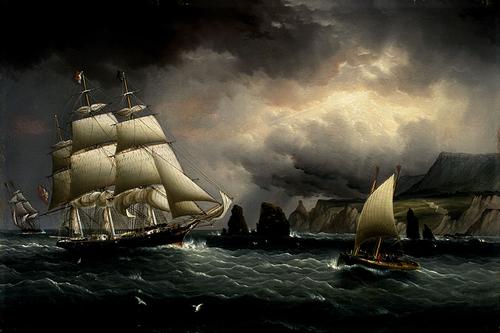
For centuries, ships have carried alien creatures from shore to shore. (Image: / )
The thought of invasion is scary, but we鈥檙e not talking earth and aliens here. Instead, the ocean shore is the new frontier, subject to an avalanche of alien creatures carried by ship. And according to a recent paper in Ecology Letters, more variables are at play than we previously knew. In other words, we鈥檙e still learning how ocean creatures deal with outside pressures.
As over centuries we have become more mobile, and as climate warms, invasive species increasingly carpet not only terrestrial habitats but marine shores, too. Threats come in the shape of distant oysters, mussels, sea squirts, filter feeders, sea grasses, algae, encrusting organisms鈥攁 multicolored array that goes on and on. They鈥檙e not getting here on their own, either; we鈥檙e bringing them, attached to the hulls of ships, fishing vessels, and recreational boats. It鈥檚 even happening , one of the last bastions of remote wilderness.
The problem is that an invasion鈥檚 success depends largely on the protective abilities of the community under attack, the Ecology Letters suggests. Yet we barely understand those abilities. That鈥檚 why beginning to comprehend how resistance works became the researchers鈥� aim. 鈥淢any invasions cost us a lot in terms of money and natural heritage,鈥� said lead researcher , in a .
By analyzing data from several published studies, Kimbro, from Northwestern University, and his team, spread across Florida State University, and the University of California at Davis, gathered information about how marine communities work. There was gaps in this research area as compared to invasions on land, which are much better understand, Kimbro says.
Terrestrial models can鈥檛 be used to explain what goes on along the ocean shore. The two environments are too distinct and complicated, we now know. For instance, aquatic creatures aren鈥檛 as good as land plants at fending off invasion unless their communities are more diverse, Kimbro found. Even with greater diversity, aquatic communities still weren鈥檛 as resilient as plant communities on land. The authors warn though that their sample size was small and that this should be taken into account when considering the results. Even so, the team went on to show that marine communities are also more at risk of destruction by invasive species that come specifically to eat. According to the study, this is because of 鈥渢he faster growth rates, smaller sizes, higher nutritional quality, and fewer defenses鈥� of marine organisms compared to plants on land.
Kimbro鈥檚 analysis identified previously unknown aspects of invasion particularly important for predicting how a marine community might fight back. Knowing invader type is valuable, as is knowing the latitude鈥攁s this decreases, a community鈥檚 ability to resist invasion actually increases. The analysis also showed that soft-bottomed, sandy seashore habitats appear to be less resistant to invasion and change鈥攁nd that these grounds should perhaps be protected specially.
There鈥檚 still more to learn. 鈥淔or the past 15 years, marine scientists have conducted a lot of experiments that have taught us a lot about specific invasions in many different places. But unlike terrestrial scientists, no one had pieced all of these unique stories together to see if they collectively tell us a general and useful message,鈥� Kimbro said in the statement. 鈥淯ntil we see cattle swimming and kudzu growing in the ocean, we can鈥檛 just recycle the messages from land studies and use them to manage our coastal systems.鈥�